White Paper on Hereditary Ovarian Cancer
In December 2024, the World Ovarian Cancer Coalition released a landmark White Paper examining the global challenges and opportunities in addressing hereditary ovarian cancer.
With inherited BRCA1 and BRCA2 mutations accounting for 10-20% of ovarian cancer cases, the report highlights a number of key recommendations aimed at closing gaps in access to genetic testing, leveraging innovative technologies, and addressing disparities across healthcare systems.
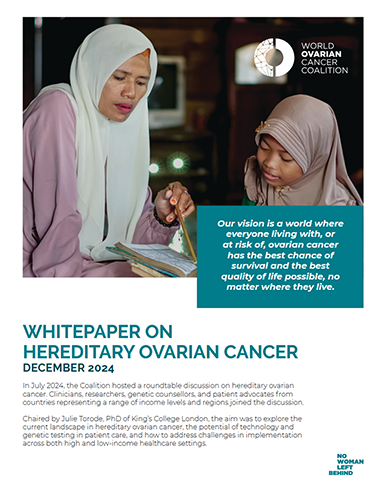
Findings and Recommendations
Many high-income countries offer routine genetic testing for ovarian cancer, yet uptake remains low due to limited awareness. In low- and middle-income countries, costs and infrastructure pose significant barriers to access.
Emerging technologies such as remote genetic counselling and AI-driven personalised risk assessments can remove logistical barriers and extend the reach of genetic testing services globally.
Evidence shows that population-wide genetic testing for cancer susceptibility genes can save lives while reducing long-term healthcare costs. Recommended approaches include government-backed initiatives and innovative co-payment models.
Priority Areas for Action
- Expand Education and Training: Equip healthcare professionals with the knowledge to bridge gaps in understanding hereditary cancer risk.
- Implement Universal Testing: Ensure comprehensive testing for tumour and germline mutations, irrespective of family history, becomes a global standard.
- Raise Awareness in Underserved Communities: Develop culturally sensitive campaigns to improve awareness and engagement.
- Strengthen Infrastructure: Build capacity to scale genetic testing and improve outcomes across diverse resource settings.
Ovarian Cancer Data Briefing
April 2024
Ovarian cancer is the most lethal of female cancers. Survival rates are low overall around the world. Incidence and mortality are on the rise everywhere, but with disproportionately higher rates in low- and middle-income countries.
This data briefing underscores the need for urgency in declaring ovarian cancer a global priority, so the increasing burden and challenges of providing the best possible care are recognised at regional, national and local levels.
If we do nothing to change the status quo…
- By 2050, just under twelve million will be diagnosed with ovarian cancer
- By 2050, 8 million women will be lost to ovarian cancer